
Hotel operations
Hotel Do Not Disturb procedure: deferred cleaning and guest privacy
Handle DND requests without losing deferred cleaning: record the service preference, agree a reoffer, assign follow-up and hand over unresolved concerns.
The short answer
Do Not Disturb (DND) records a guest's preference not to be disturbed; it does not establish whether a room is occupied, dirty or clean. Defer routine cleaning, record what remains undone and agree any later contact or service with the guest. Assign follow-up and refer prolonged DND or welfare concerns to a trained manager under the property's procedure.
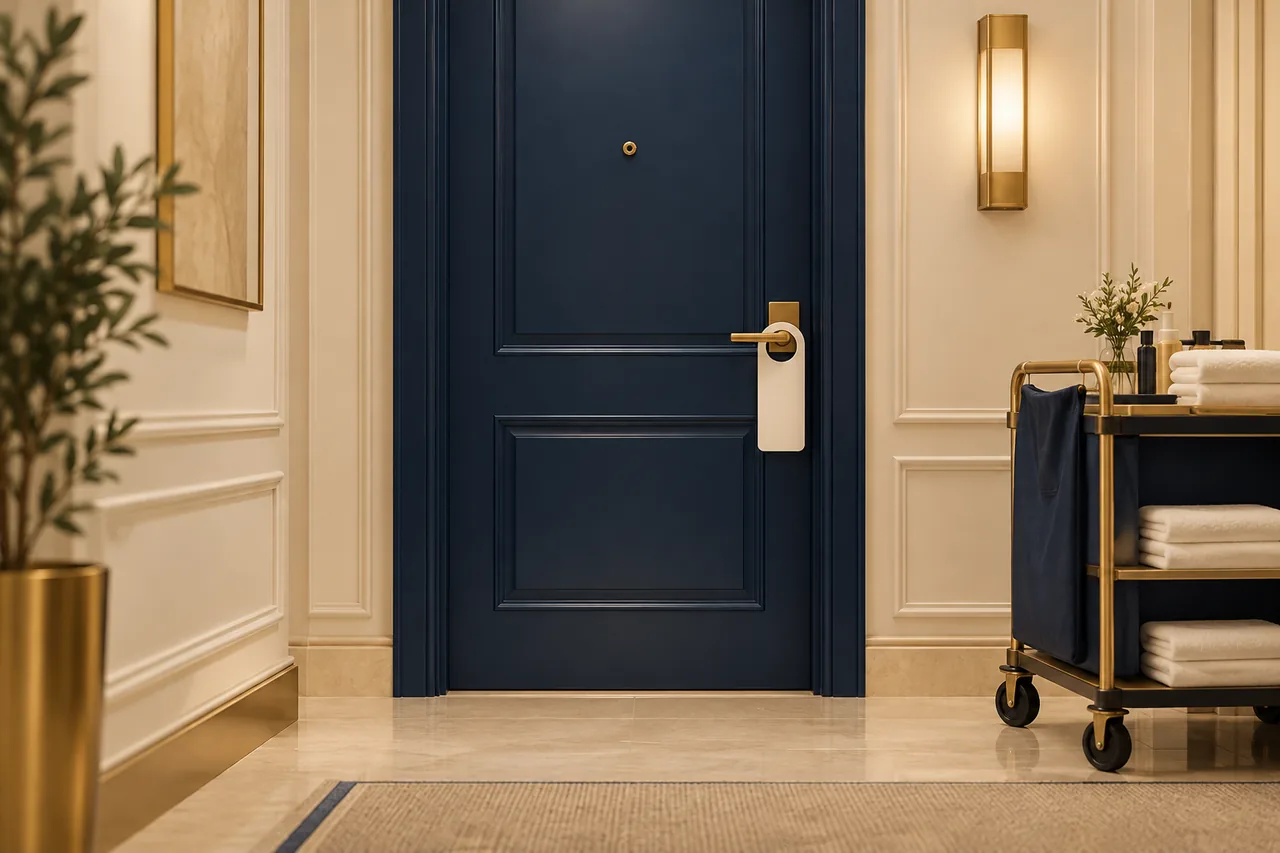
A Do Not Disturb sign can interrupt a planned cleaning round without cancelling the hotel’s responsibility to manage the unfinished work. The practical challenge is to respect the guest’s preference while keeping a reliable record for reception, housekeeping and the next shift. A room skipped during the morning round should remain visible as deferred work.
For a small hotel, the process can be simple: one shared operational record, one colleague responsible for follow-up and a clearly agreed next action. Repeated knocking by different employees usually indicates a coordination problem, not a lack of effort.
Separate the service preference from room condition
Oracle’s housekeeping service documentation describes Make Up Room (MUR) and Do Not Disturb (DND) as guest housekeeping service statuses. These labels express a service preference.
Keep that preference separate from occupancy, physical cleanliness and task progress. A guest may be out while the DND hanger remains displayed. A previously cleaned room may still show DND. Neither observation authorises changing the occupancy record or claiming that today’s cleaning happened. The housekeeping and room-status guide explains those separate operational records.
Use factual wording: “10:15, DND displayed, routine service deferred, no entry.” Avoid “guest asleep” unless the guest actually said so. Record only information needed to organise the service, without guessing why privacy was requested.
Make deferral a visible task
When an attendant encounters DND, follow the property’s routine service procedure and notify the housekeeping lead. Record the time, room, unperformed work and responsible colleague. Reassign the attendant to an available task while the deferred room stays on the follow-up list.
Do not mark cleaning complete to clear the daily board. If only towels were delivered with the guest’s agreement, record that limited service accurately. Bed making, bathroom cleaning and replenishment remain unfinished unless performed. A separate note or controlled service log may be needed where the software does not provide a dedicated deferral field.
The lead should review outstanding work before the service team’s availability changes. This review creates an opportunity to arrange a realistic service window; it does not create permission to enter or contact the guest against their preference.
Agree a reoffer without creating another disturbance
Use a contact channel and time the guest has approved. For example, a guest speaking to reception can be offered afternoon cleaning, fresh towels at an agreed collection point, or no routine service that day. Explain available service windows before promising a precise time.
If no later contact has been agreed, follow the property’s procedure for handling the request. Do not assume that DND permits a phone call simply because knocking was avoided. Where instructions conflict, have the responsible colleague clarify them through an agreed channel before routine entry.
Record the guest’s decision in operational terms: requested service, agreed time, contact permission and owner. A request for two towels is not permission for full room cleaning. If the agreed visit cannot happen, the same owner arranges an update rather than leaving another shift to guess.
A hypothetical afternoon reoffer
At 10:15, an attendant finds DND on room 204 and records deferred cleaning without entering. At 12:30, the guest visits reception and requests cleaning between 15:00 and 16:00. Reception confirms availability with the housekeeping lead and records permission for a message if the timing changes.
At 15:00, the DND hanger is still displayed. The assigned colleague uses the approved message channel to clarify the conflicting instructions. The guest replies that only fresh towels are needed and agrees to collect them at reception. The team records towel delivery and the declined full service; the cleaning task is not reported as completed.
If the guest later questions the missed cleaning, the guest complaint handling guide helps the team establish the facts and agree a remedy without debating the guest’s motives.
Hand over the next action, not just “DND”
Use this checklist in the front-desk shift handover:
- Room and time of the last factual observation.
- Routine work deferred and any limited service actually delivered.
- Guest-approved contact channel, timing and agreed service scope.
- Named follow-up owner and next review time.
- Any unresolved concern already referred to the duty manager.
Prolonged DND or a concern about guest welfare belongs with a trained manager under the property’s established procedure. An attendant should not invent a universal entry deadline. Urgent concerns require the property’s emergency response, with decisions handled by authorised staff.
Frequently asked questions
Does DND mean the room is dirty? No. Service preference, room condition and occupancy describe different facts.
Can an unperformed clean be closed as completed? No. Record deferral or declined service separately and preserve what actually happened.
Does BirOtel automatically receive DND signals? A dedicated DND control, door-device connection and automatic status integration are not confirmed. Check the proposed recording method during a demonstration.
BirOtel supports room management and housekeeping task assignment, priority and progress. Bring this scenario to a small-hotel software demonstration and agree how your team will record deferred service and follow-up.
These guides are published by BirOtel. General methods, illustrative examples and current product capabilities are identified separately. Sources appear beside the relevant explanations.
[email protected]Explore these workflows for your own hotel
Use your room inventory and daily tasks to assess whether BirOtel fits your hotel in a live demo.