
Hotel operations
Hotel housekeeping trolley checklist: prepare, restock, return
Prepare a housekeeping cart for the next room round, separate supplies, calculate a practical load and hand it back ready for the next shift.
The short answer
Prepare the housekeeping trolley for the rooms you will service before the next planned refill. Check its condition, count the required linen and supplies, keep clean and used items separate, and secure equipment. Replenish against the remaining work during the shift. At return, remove used materials, clean the cart under local procedures, record shortages and confirm who prepares it next.
A hotel housekeeping trolley checklist should answer three practical questions: what leaves the service room, what needs replenishing during the round, and what the next employee receives. A trolley can look full while missing the pillowcase size needed for the first room. Preparation starts with the actual assignment and ends with a clear return routine.
This suggested workflow is for room attendants and supervisors. Adapt its quantities and layout to your property, equipment and approved procedures. It is a working preparation sheet, separate from the hotel’s complete stock inventory.
Start with the next service round
Read the confirmed assignment before loading. Note departures, stayovers, bed configurations, requested changes and the next accessible refill point. A stayover does not automatically require the same supplies as a full departure clean. Check the hotel’s service agreement and recorded requests rather than guessing from occupancy alone.
Choose a manageable round between replenishments. Housekeeping workload planning decides which employee handles each task; this sheet translates that employee’s next tasks into physical supplies. Record the cart identifier, employee, preparation time and intended refill point so a colleague can understand the plan if the route changes.
Check the equipment before adding stock
Look for damaged wheels, loose fittings, an unreliable brake where fitted, leaking containers or a door that will not close. Report a defect and follow the hotel’s equipment procedure instead of compensating with a heavier push. Check that approved holders and bags are fitted correctly.
Use the manufacturer’s instructions for loading, attachments and load limits. There is no universal safe kilogram allowance for every trolley. Before leaving, confirm a clear view ahead, stable contents and a route through the relevant doors and lift. If the load cannot be managed comfortably, stop and ask the supervisor to revise the round or equipment arrangement.
Give each category a predictable place
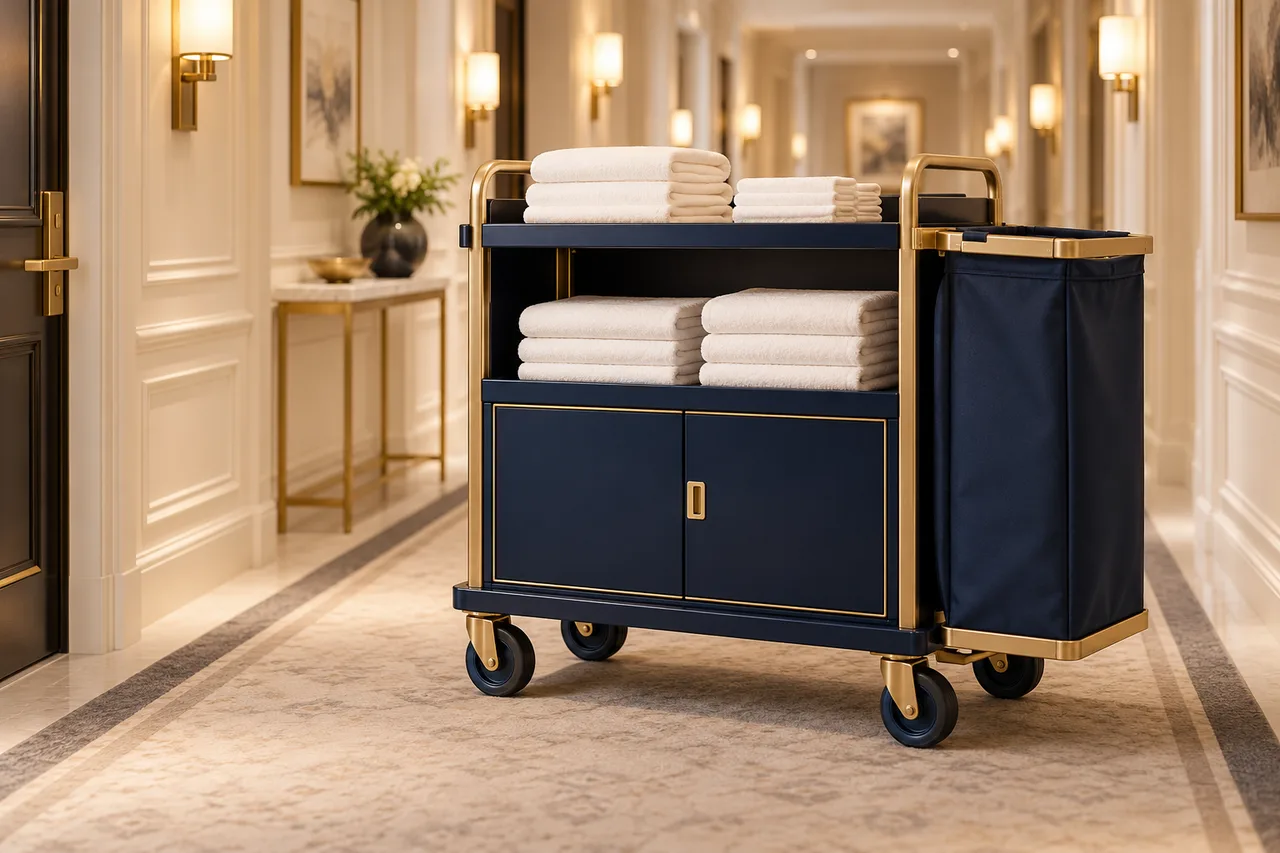
Rubbermaid’s housekeeping cart overview describes separate linen and waste bag options, organizers and lockable configurations. Available compartments depend on the model; check your own cart rather than assuming every feature is fitted.
Use a simple placement plan that a replacement employee can follow. Keep clean linen protected and separate from used linen, waste and cleaning equipment. Keep bottles in their designated secured compartment, away from guest supplies. Separate collection routes for used linen and rubbish should remain identifiable throughout the round.
Ecolab’s lodging guide stresses product-label instructions, suitable protective equipment and cloth separation by task. Follow the property’s trained method; this checklist does not specify chemical mixtures or dilution recipes.
Count items against a clearly defined round
Consider this fictional stocking example, not a hotel standard. One attendant has four departure rooms and two stayovers before a planned refill. All six rooms have the same bed configuration. In this example only, each departure needs two pillowcases and two bath towels; each stayover has a confirmed request for one bath towel and no linen change.
| Item | Expected use before refill | Chosen example reserve | Starting quantity |
|---|---|---|---|
| Pillowcases | 4 × 2 = 8 | 2 | 10 |
| Bath towels | (4 × 2) + (2 × 1) = 10 | 2 | 12 |
| Bath mats | 4 × 1 = 4 | 1 | 5 |
The reserve is a local planning assumption. It is not a recommended percentage or permission to exceed equipment limits. Count sheets, duvet covers, cloths, guest supplies and bags on separate lines according to the actual room specification. This shortened table is not a complete room kit.
If the property lacks enough clean stock, record the missing item and inform the supervisor before departing. Do not label the trolley ready because the total number of pieces looks sufficient. Linen inventory planning addresses the wider stock position; this count concerns what is available on this cart now.
Use a short departure checklist
- Assignment and service requests checked against the current round.
- Cart condition checked and defects passed to the responsible person.
- Correct item sizes and starting quantities counted.
- Clean supplies, used-item collection and waste collection separated.
- Containers identified, closed and secured under local procedures.
- Tools secured, contents stable and passage through the route checked.
- Refill location, timing and shortage contact agreed.
Tick only what has actually been checked. If someone finishes preparation for you, review unresolved items together instead of copying their initials onto your own sheet.
Replenish before the next room becomes a problem
At the agreed refill point, compare remaining stock with remaining tasks. In the example, completing three departure rooms uses six bath towels, leaving six. The remaining departure and two requested stayover changes need four, so two remain as reserve if nothing else changes.
An additional confirmed request changes that calculation. Record the adjustment, replenish the specific item and reassess the next round. Avoid adding a second full load on top of whatever remains. Transfer shortages to the supervisor with an item, quantity and required time; “we need supplies” is difficult to act on.
Park only in approved locations, maintain access and secure the trolley according to the property’s rules whenever it is unattended. A full shelf does not justify blocking a doorway or leaving supplies accessible to guests.
Return a usable cart and a clear record
At the designated service area, route used linen and waste to their separate collection points. Handle unused clean supplies according to the property’s return rules. Complete cart cleaning and equipment checks before restocking; do not place fresh supplies onto an unprepared surface.
Record shortages, defects and the person responsible for follow-up. Agree whether the returning employee or incoming shift completes the next load. Cart readiness and room inspection remain separate checks: a prepared trolley does not confirm a finished room.
Frequently asked questions
Should the trolley carry a whole shift’s supplies? Only if the planned work, equipment limits and local procedure support it. A scheduled refill can be more practical.
Can unopened spare supplies go straight back into storage? Follow the property’s return criteria, including packaging condition and possible exposure. Unused does not automatically mean suitable for return.
Who owns an unresolved shortage at handover? Name the employee or supervisor accepting it and the next action. Leaving a note without an owner does not complete the handover.
These guides are published by BirOtel. General methods, illustrative examples and current product capabilities are identified separately. Sources appear beside the relevant explanations.
[email protected]Explore these workflows for your own hotel
Use your room inventory and daily tasks to assess whether BirOtel fits your hotel in a live demo.