
Hotel operations
Water leak at a hotel: a first-response checklist for staff
A practical hotel water-leak response: keep guests clear, alert qualified staff, arrange an authorised room move and record who can reopen the affected area.
The short answer
Keep people away from the affected area, inform the duty manager and qualified technical staff, and follow the hotel's emergency procedure if there is immediate danger. Record the location and observed conditions without entering the hazard. Arrange an authorised room move when needed, and reopen only after the responsible staff have confirmed that the area is safe.
A guest reports water spreading from a bathroom into the corridor. Another guest is approaching with a suitcase, while housekeeping asks whether to bring a mop. The first operational decision is who will protect people and coordinate the response. Identifying the damaged pipe can wait for qualified staff.
This checklist is an editorial workflow for hotel teams in Azerbaijan. Adapt responsibilities and escalation contacts to the property’s emergency plan. It is not plumbing or electrical repair instruction, and the international safety references below are not presented as Azerbaijani legal requirements.
1. Establish what is happening from a safe position
Record the floor, room or corridor section and time of discovery. Ask whether anyone is still in the affected space and whether assistance is needed. Describe only what can be observed safely: water crossing a doorway, dripping from above or a guest reporting a bathroom overflow.
Do not call the water clean, identify a failed pipe or declare the room safe without an appropriate assessment. “Water visible outside room 204; source unconfirmed” is more useful than a confident diagnosis. Keep the initial description short enough for the duty manager to act on immediately.
If there is apparent immediate danger, use the hotel’s emergency escalation route and local emergency arrangements without waiting for a routine maintenance ticket. Do not enter a hazardous area to take photographs or retrieve belongings.
2. Protect the approach to the area
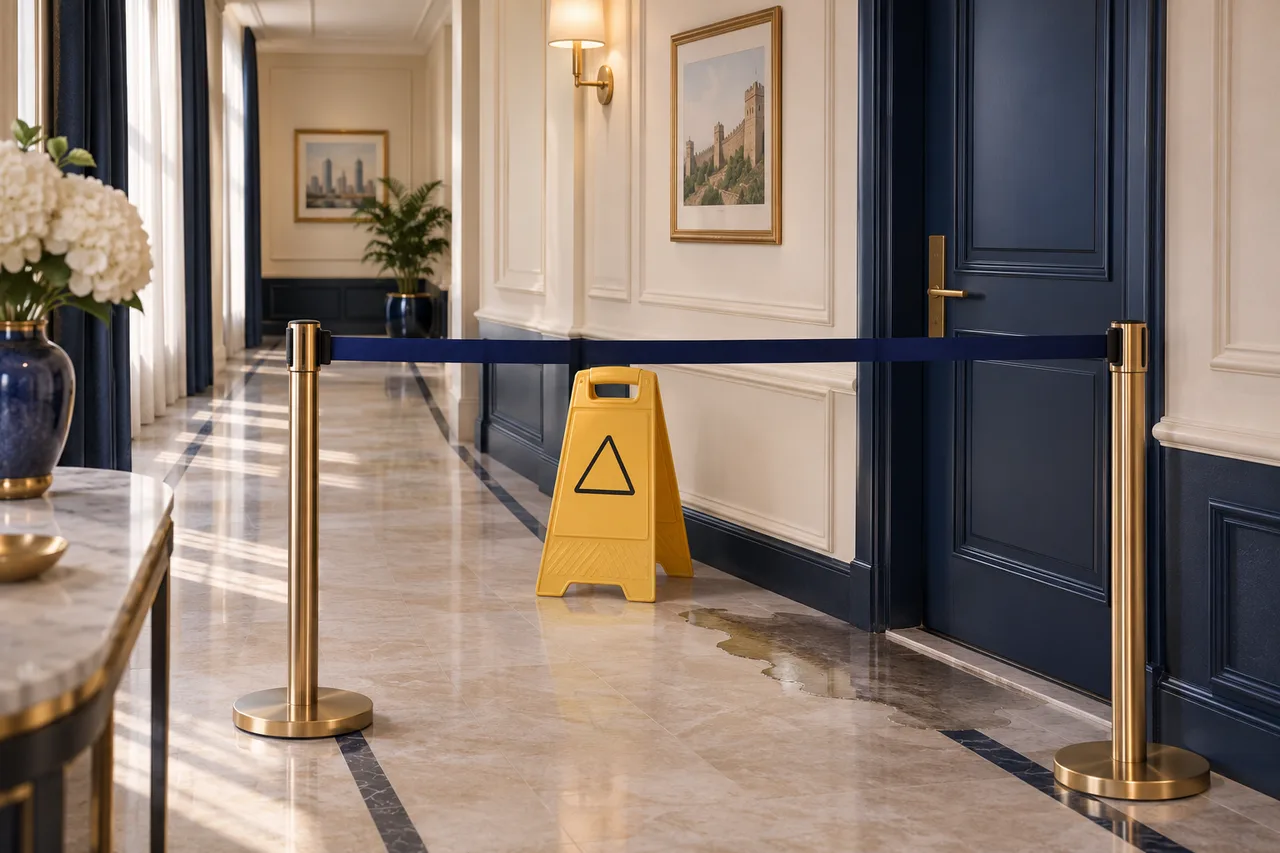
The UK Health and Safety Executive’s wet-floor guidance explains that signs and cones warn people but do not prevent entry. Apply that distinction when organising access control: a warning sign alone does not complete the response.
Have an assigned employee direct approaching guests along an approved safe route while the responsible team arranges suitable separation. Keep emergency exits usable; do not improvise a barrier that obstructs an escape route. Tell reception which rooms or routes are affected so staff do not send another guest into the same area.
Electrical concerns require qualified personnel. CDC guidance for returning after a disaster warns against operating power controls or electrical equipment when wet or standing in water. The relevant principle here is to avoid handling electrical systems and escalate; this article does not instruct hotel staff to isolate electricity.
3. Give the response a named owner
Notify the duty manager and the hotel’s designated technical contact. Ask for acknowledgement, not merely a message-delivered indicator. If the first contact does not respond, follow the property’s escalation sequence. One named coordinator should maintain the current picture while other staff assist guests.
Use this short internal message, replacing the example details:
14:20 — water visible outside room 204 and spreading into the corridor. Source unconfirmed. Guests are being redirected at the safe approach. Duty manager and technical team requested. Please confirm who is attending and who will update reception. Affected room remains unavailable pending assessment.
Send operational information through the approved staff channel. Avoid guest names, photographs of personal possessions or speculation about fault in a broad group message. Photographs, if needed, should be taken only from a safe position and stored under the hotel’s incident procedure.
4. Support the guest without promising an outcome
Explain what staff know and when the guest will next receive an update. “Our responsible team is assessing the area; reception will update you at the agreed time” is preferable to inventing a repair duration. Keep the update appointment even if assessment is still underway.
If accommodation is affected, the authorised manager should approve the next arrangement. Follow the hotel room-move checklist for availability, keys and reservation details. Keep retrieval of belongings separate from the relocation decision: moving a guest does not authorise entry into an unsafe room.
5. Separate containment from reopening
A stopped drip or wiped floor is not a completed clearance. The coordinator should obtain the appropriate technical and operational checks before a room or route is returned to use. Record who approved reopening, when, and any remaining restrictions or follow-up work.
Before the shift ends, confirm:
- Who owns the unresolved incident and the next update.
- Which rooms or routes remain unavailable.
- What the guest has been told and what is still pending.
- Which assessment or clearance is required next.
- Whether reception and the responsible departments have acknowledged the current status.
Carry those facts into the front-desk shift handover. A new shift must inherit the restriction and its owner, not just the note “leak dealt with”.
Frequently asked questions
Should housekeeping start mopping immediately?
Only when the responsible assessment allows cleaning and staff can work safely under the hotel’s procedure. A cleaning request must not replace hazard assessment.
Can reception promise a repair time?
Only relay a confirmed estimate from the responsible team and describe it as an estimate. Otherwise promise a specific next update, not completion.
Who decides that guests can return?
The hotel’s designated responsible person, using the relevant technical and operational clearance. Record that decision; the absence of visible water is insufficient.
These guides are published by BirOtel. General methods, illustrative examples and current product capabilities are identified separately. Sources appear beside the relevant explanations.
[email protected]Explore these workflows for your own hotel
Use your room inventory and daily tasks to assess whether BirOtel fits your hotel in a live demo.